![trace-logo-full-colour-rgb-1878px@72ppi.png]](https://trace.weareisla.co.uk/hs-fs/hubfs/trace-logo-full-colour-rgb-1878px@72ppi.png?height=50&name=trace-logo-full-colour-rgb-1878px@72ppi.png)
When you pick the fossil fuel tariff in TRACE, we use the grid electricity factor published by DESNZ, the UK government department that sets the official factors. That factor already takes account of everything feeding the grid: gas, wind, solar, nuclear, imports and the rest.
So it isn't the footprint of a gas power station. It's the average for the grid your venue or office is plugged into. This is known as the location-based method for accounting for your scope 2 emissions.
Over the past year, gas made up about 27% of Great Britain's electricity, and wind, solar, hydro and nuclear together made up more than half. The DESNZ factor takes into account that mix when the carbon factor for energy usage is updated.
We'll use live data from National Grid: Live to show how the mix turns into a number, and why that number won't always match your TRACE results.
Location-based and market-based: what's the difference?
The GHG Protocol allows two ways to count emissions from the electricity you buy (Scope 2).
|
Location-based |
Market-based |
|
|---|---|---|
|
What it measures |
The average emissions of the grid you draw power from |
The emissions of the electricity your supplier contracts to buy for you |
|
Does your tariff change it? |
No. Everyone on the same grid gets the same factor |
Yes. A certified renewable tariff can bring generation emissions to zero |
|
Where the factor comes from |
National averages (DESNZ in the UK) |
Your supplier's fuel mix or renewable certificates |
|
In TRACE |
Fossil fuel tariff: grid-average factor applied |
Renewable tariff: generation rated at 0 |
If you choose the renewable tariff, transmission and distribution (T&D) losses still count, along with the upstream well-to-tank (WTT) emissions tied to them, because the power still travels through the grid. TRACE also keeps the location-based figure in the background, so you can report both if CDP or a similar framework asks. The TRACE Events Methodology has the full detail.
What the UK grid is really made up of
Over the past 12 months, fossil fuels supplied 27% of Great Britain's electricity, down from a 46% average since 2012. Over the same period, average carbon intensity halved from 251 to 122 g of CO2 per kWh.
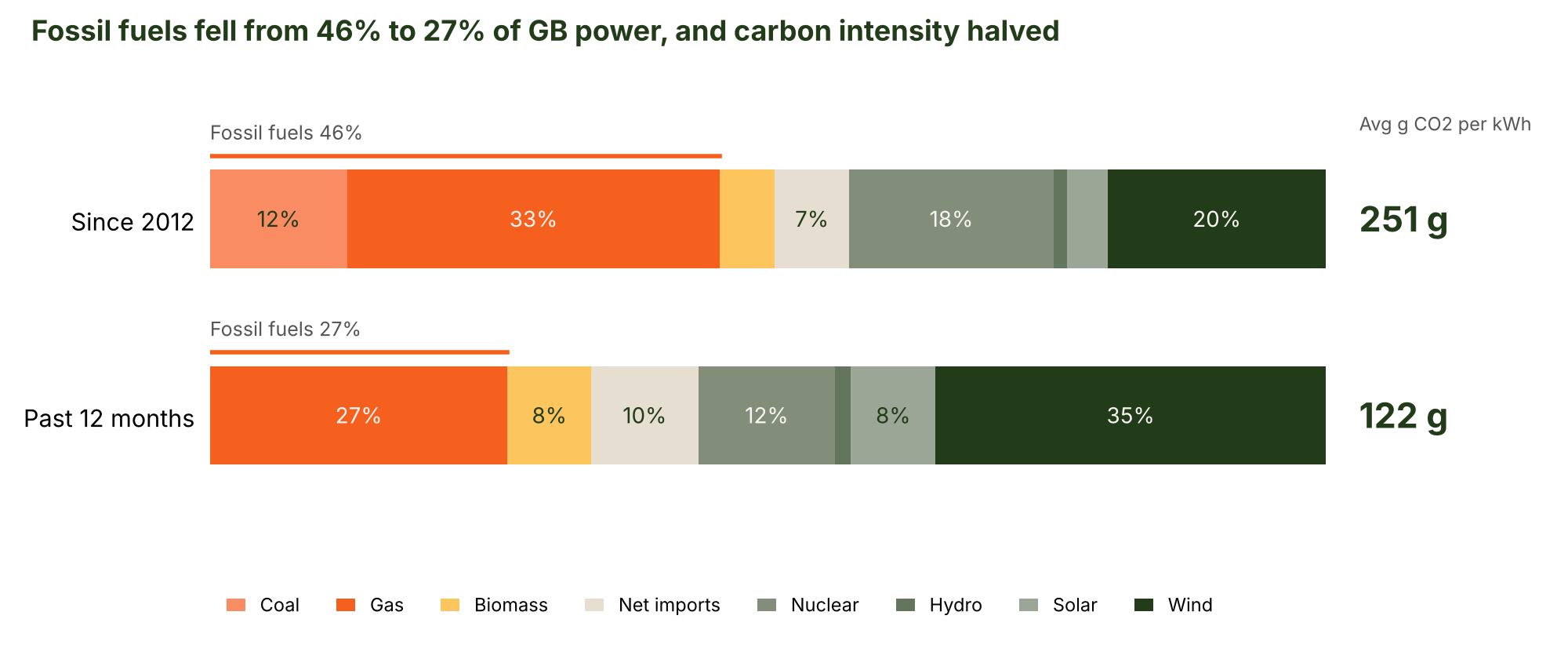
Source: grid.iamkate.com, viewed 15 Oct 2026. Average since 2012 vs past 12 months. Net imports shown, storage excluded. Contains BMRS data © Elexon Limited copyright and database right 2026.
Most of that change is wind, which now supplies about a third of generation, and coal, which has gone completely. The mix also shifts through the day. On a windy day gas can fall to a small share of generation. On a still winter evening it can be several times that.
From grid mix to carbon factor
A grid carbon factor is essentially a weighted average. Each power source has its own emissions per kWh, and it counts in proportion to how much of the grid's electricity it supplied.
As a country builds more wind, solar and hydro and relies less on fossil fuels, its grid factor comes down. The factor follows the real emissions from the electricity being generated, so a cleaner grid shows up as a lower number in your footprint.
What this means for your results
- Your emissions can drop when nothing changed on site. The 2026 UK factor fell 26%, partly because the grid got cleaner and partly because DESNZ now uses more recent data. Put kWh next to kgCO2e in your reports so readers can see what really moved.
- The fossil fuel tariff reflects the grid as it is, and its factor falls as the grid gets cleaner.
- A renewable tariff removes generation emissions only. T&D and WTT on losses stay. The zero is only as good as the certificates behind the tariff, so ask your venue or supplier what backs it.
- Using less electricity is the one change guaranteed to lower your footprint, whichever accounting method you use.
Beyond the UK
This article uses the UK as its example, but every country's grid has its own mix of fuel sources, and the same logic applies. A grid with more low-carbon generation has a lower factor.
For venues outside the UK, TRACE uses that country's own published factor, such as the EPA in the US, RTE in France and AIB for several European countries. The same kWh can carry a very different footprint depending on where your event runs.